


How Immigration Crackdowns and Aid Cuts Are Reshaping Migration Across Central America
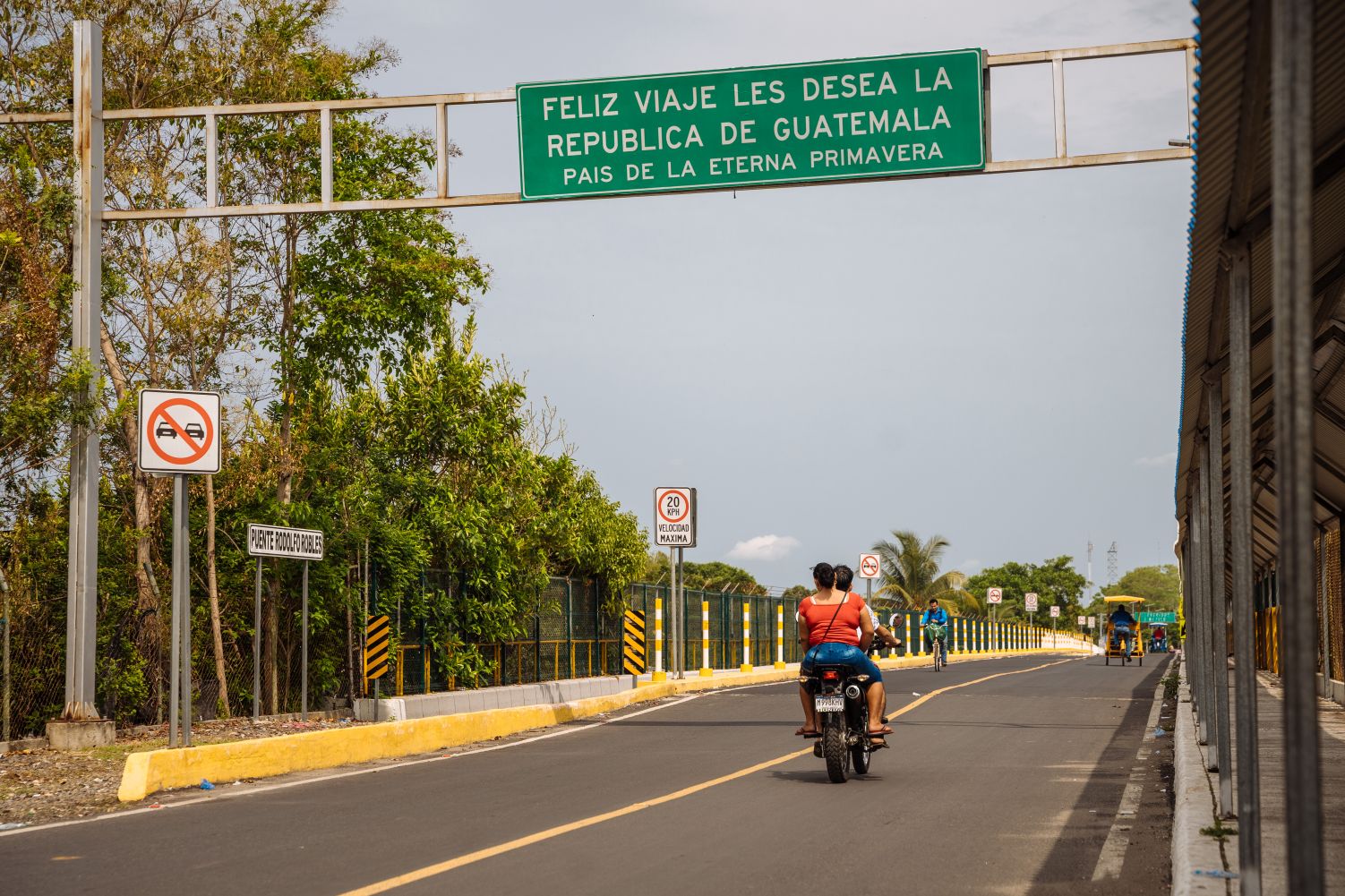
People on a motorbike at the Guatemala-Mexico border. (Photo: IOM/Muse Mohammed)
Central America's migration patterns are undergoing a profound transformation. Once primarily a region of emigration and northward transit, it is increasingly becoming a place of prolonged wait, return, and long-term stranded mobility. Migrants now arrive, stay, are returned to, or move through the region in multiple directions—often without clear pathways forward or adequate protection. At the same time, governments and communities trying to respond to this shift are doing so with weakened services and supports, complicating efforts to adjust to the new reality.
These changes reflect two connected trends: the spread of restrictive immigration policies, particularly in the United States, and a sharp drop in global humanitarian funding. Tighter border controls, limits on asylum, fast-track deportations, and international agreements that shift responsibility onto heretofore transit countries have made onward movement more difficult, even as displacement pressures persist. Many of these policies were designed by the United States but have taken root far beyond its borders. At the same time, cuts to humanitarian assistance by long-time international donors have reduced access to shelters, legal aid, food, and health care, leaving many migrants without support when they are blocked from moving onward or are forced to return. Some of the shifts have been underway for years, but became more exaggerated since the Trump administration’s return to power in 2025.
As such, recent declines in irregular northbound migration and the sharp drop in unauthorized crossings of the U.S.-Mexico border do not reflect reduced pressures for migration. Rather, they signal a reconfiguration of movement: Mobility has become more fragmented, less linear, and more coercively shaped. Many migrants have returned to Central America, whether through deportation, voluntarily out of fear of possible deportation or in response to more punitive government postures, after abandoning their journeys, or for other reasons. Some migrants from outside the region have been forced to wait for prolonged periods in transit countries, while others have been rendered effectively immobile in places they never intended to settle. Among these are some who have been displaced and need protection, others who migrated for economic or personal reasons, and many driven by a confluence of factors.
These changes have profound implications. Central American countries have become responsible for populations they were not prepared to host, amid shrinking international support and without reliable data to assess need or efficacy of responses. Humanitarian aid cuts have reduced protection capacity as individuals’ needs have become more complex and more profound.
This article examines how the interlinked tightening of U.S. immigration policies and contraction of humanitarian and development assistance are reshaping mobility across Central America. It draws in part from the 2026 study Nuevas Dinámicas Migratorias en la Región Centroamericana: Repensando el Contexto de Movilidad Humana y Desafíos en el Sector Humanitario (New Migration Dynamics in the Central American Region: Rethinking the Context of Human Mobility and Challenges in the Humanitarian Sector), co-written by the authors and published by the Lutheran World Federation and the University of Southampton.
Central America’s Shifting Migration Landscape
Historically, countries such as El Salvador, Guatemala, and Honduras were primarily places where migration originated, with large-scale emigration to the United States and, to a lesser extent, Mexico. These movements were shaped by legacies of civil conflict, structural poverty, gang violence, and weak state protection, and were accompanied by longstanding patterns of return, often through deportation. By 2023, about 85 percent of all 4.3 million Central American immigrants in the United States were from one of these three countries, many of them without authorized status. Remittances had become a cornerstone of national economies—reaching roughly 24 percent of the gross domestic product (GDP) of El Salvador, according to the World Bank.
Since 2014, and especially following the COVID-19 pandemic, this pattern began to change rapidly. Central America experienced rising migration from South America—including of nationals of Caribbean, African, and Asian countries—via the remote Darien Gap as well as air and sea routes into Nicaragua, with most people headed for North America. Many migrants only got as far as Panama or Nicaragua before running out of the resources to continue northward. This pressured governments to meet emerging needs and expand or create services—often in remote, impoverished areas—while managing varying degrees of pressure from the United States and others to curb northward migration.
Since 2024, increasingly restrictive U.S. immigration measures—including closed asylum pathways, accelerated deportations, and the end of various Temporary Protected Status (TPS) designations and a parole program for Cubans, Haitians, Nicaraguans, and Venezuelans—sharply reduced irregular northward movement. These policies, alongside efforts to reduce transit through corridors such as the Darien Gap, reshaped migration once again. In the first quarter of 2025, Guatemala, Honduras, and Panama reported between 89 percent and 97 percent less irregular migration than in the same period in 2024, while U.S. authorities’ encounters of unauthorized migrants at the southern border were 79 percent lower in fiscal year (FY) 2025 than in FY 2024, and reached the lowest levels in decades.
New Mobility Outcomes: Transit, Return, and Immobility
While northbound movement has declined, overall mobility in various directions has not stopped. Instead, migration has been reshaped into overlapping and multidirectional trends: prolonged transit, forced and induced return, southward movement, and immobility in both transit and return countries.
As access to the U.S. asylum system has narrowed in recent years, more people have sought protection in Central America. In Costa Rica, for instance, asylum claims by Venezuelan, Cuban, Colombian, Haitian, and Chinese migrants increased sharply in 2024. Similarly, according to the UN High Commissioner for Refugees (UNHCR), asylum applications in Honduras rose in 2025, although the numbers were just a fraction of those filed in places such as the United States.
Meanwhile, forced returns to some countries in the region have been on the rise, including of people from outside Central America as the U.S. government has struck third-country deportation arrangements. After being deported, however, some migrants have tried to go north again.
From Transit to Containment and Stalled Mobility
Across Central America, transit migration has sharply declined, reflecting a broader shift from large-scale northwards movement to both containment and stalled mobility. Declining border crossings are not simply a sign of fewer arrivals, but rather evidence of changing patterns.
Honduras illustrates this transition. In 2023, it recorded more than 545,000 irregular transit entries, primarily by Venezuelans, Cubans, and Haitians. Transit volumes declined to approximately 369,000 in 2024 before collapsing to just over 39,000 in 2025, an almost 90 percent reduction from 2023 and one of the steepest contractions in the region. Still, Honduras registered a monthly average of nearly 4,800 irregular border crossings in early 2025, indicating that some degree of mobility persisted, albeit at a much lower scale.
Guatemala experienced a similar contraction. Enforcement actions against irregular migrants fell by approximately 90 percent from the first quarter of 2024 to the same period a year later. While Venezuelan, Colombian, and Ecuadorian nationals had predominated in earlier years, 2025 saw a shift toward more Salvadoran, Cuban, and Haitian migrants, although Venezuelans remained numerous. Notably, the continued presence of families and children underscores that even as overall volumes decreased, some number of individuals likely still had protection concerns.
Deportation, “Arrepentidos,” and Induced Return
Return dynamics have also changed markedly. Deportations from the United States to northern Central America remained high and, in some cases, increased, particularly of migrants with no criminal record. In 2025, Honduras received nearly 43,000 deportees, up 25 percent from the previous year. El Salvador received more than 16,000 and Guatemala about 55,000, though the latter number marked a 23 percent decline from the previous year. Moreover, a greater share of deportations is now occurring from within the United States, rather than of people arrested at the border, meaning that individuals tend to have lived for significant periods in the United States and return with different needs than those in the past.
Deportations, however, represent only part of the return picture. Many Central Americans who were not deported were nonetheless induced to come back, amid a broader U.S. government posture of hostility towards immigrants without legal status. It is unclear how many unauthorized immigrants have “self-deported,” but data obtained by CNN showed that, as of March, 72,000 people of all nationalities had left with the help of a government program known as Project Homecoming to encourage their departure (many after periods in immigration detention). The Department of Homeland Security (DHS) claimed that almost 3 million unauthorized migrants had left the United States during the first year of the Trump second term, including 2.2 million self-deportations and more than 675,000 formal deportations, however it has not provided detailed data to support this claim.
Flows Reverse
In Panama, as northward migration declined, southward movement increased. Between February and May 2025, around 8,000 people—one-third of them women—retraced their steps through the Darien, twice the number who crossed northward during the same period. Still, this southbound traffic is a tiny fraction of the more than 520,000 people who crossed northward in 2023.
Among those returning south are migrants who abandoned their journey after failing to reach the United States, as well as third-country nationals deported by the United States to Costa Rica and Panama who may continue toward Colombia or elsewhere. Nearly 300 people were brought to Panama through an agreement with the United States, as part of a broader and increasingly opaque system for third-country deportations, and roughly similar numbers were removed to Costa Rica. Mexico receives a larger number of third-country deportees. Overall, the United States deported approximately 15,000 people in 2025 to a country to which they had no prior connection, according to Migration Policy Institute (MPI) estimates.
Some also abandoned their journeys before reaching the United States. Known as arrepentidos (Spanish for “the regretful”), they returned not because conditions at home had improved, but because northward movement became legally and materially impossible, amid mounting restrictions in the United States, Mexico, and other countries. The authors have documented a rise in such returns, though official data are scarce. Survey data of mostly South American migrants from the Mixed Migration Centre show that, in mid-2025, two-thirds of respondents who had abandoned their journey said northward migration was “no longer possible.” Many of these ostensibly voluntary returns were shaped by restrictions and deterrence policies, migrants’ exhaustion and lack of viable alternatives, and exposure to multiple forms of violence in transit, including crime and abuse by authorities.
Stranded Migrants and Enforced Immobility
As mobility has become increasingly constrained, a growing number of migrants have found themselves stranded. Many of those affected are from outside the region and face significant barriers to return, including high costs, insecurity, and administrative obstacles. In Mexico, tens of thousands of people have effectively been stuck in recent years, including in southern border regions such as around the city of Tapachula, where policies designed to deter northward movement have left many waiting indefinitely with few options to continue their travel. In 2023, a high of 140,000 asylum claims was filed in Mexico. Local authorities in Chiapas, the state encompassing Tapachula, reported more than 34,000 asylum applications in the first nine months of 2025, with many migrants remaining for extended periods while their claims were processed.
Large numbers of these stranded migrants have limited legal status or access to services. Sizeable humanitarian needs exist across Central America, including in the areas of shelter, food, health care, and protection. As individuals have returned to the region and in some cases become increasingly immobile, their protection needs have often remained unmet. UNHCR promotes three solutions for people in need of protection: local integration, voluntary return home, and resettlement elsewhere. But with declining international support, it is unclear how Central America will ensure the wellbeing of these individuals.
Humanitarian Aid Contraction and Its Consequences
As displacement patterns have evolved, shrinking humanitarian aid has threatened the region’s capacity to respond. Nicaragua, Honduras, and Guatemala are some of Latin America’s poorest countries, with half the populations in poverty and many facing food insecurity. The region is highly dependent on foreign support, much of it from the United States, but both U.S. and global support have contracted.
Worldwide, official development assistance fell by 9 percent in 2024 and as much as 17 percent in 2025, according to the Organization for Economic Cooperation and Development (OECD), while the World Food Program projected a 40 percent decline in funding for 2025. According to the UN Office for the Coordination of Humanitarian Affairs (OCHA), as of 2025, 71 percent of organizations and agencies affected by the termination of U.S. foreign aid worldwide reduced services and at least 12,000 staff contracts were terminated. Organizations led by women or refugees and those working on social protection, child protection, and gender-based violence have been among the most affected.
These reductions have had immediate effects in northern Central America, forcing organizations across the region—including those that might help migrants and returnees—to scale back or close. In 2025, humanitarian needs and response plans for the region were funded at critically low levels: less than 11 percent in Honduras, 18 percent in Guatemala, and 22 percent in El Salvador. These shortfalls have significantly undermined the capacity of humanitarian actors to provide shelter, food, protection, and legal assistance to migrants and returnees.
As humanitarian support contracts, remittances have become an increasingly important buffer for many households. Despite intensified immigration enforcement in the United States, individuals abroad sent an estimated $55.4 billion to Central American countries in 2025, representing an increase of more than 20 percent over 2024. Some analysts suggest this rise may reflect migrants’ anticipation of potential detention or deportation, prompting efforts to transfer savings before such events. Yet reliance on remittances can also deepen recipients’ vulnerability, as livelihoods become tied to precarious labor conditions and shifting enforcement dynamics abroad.
Downstream Impacts and Challenges in a Context of Constraint
These developments—new mobility patterns and reduced international aid—raise fundamental questions about the future for displaced people and other migrants in Central America, including both returnees from the region (those leaving forcibly, coercion, and voluntarily alike) and non-Central Americans who have been forcibly returned or stranded during their journeys. These groups face different challenges shaped by nationality, gender, socioeconomic status, race/ethnicity, and legal status, requiring adaptable and dynamic policy responses.
Pre-existing policies have struggled to ensure sustainable and successful reintegration; violence, poverty, and persecution drive many to re-migrate following return. Governments have for years run initiatives including reception centers for deportees, municipal reintegration units, and vocational training programs. This includes Guatemala’s Quédate centers and employment programs in Honduras and El Salvador. However, these efforts have largely focused on short-term assistance or economic reintegration and often lack the resources, scale, and coordination to support long-term stability. Many programs do not address broader protection needs, including exposure to violence, lack of housing, or psychosocial support.
As a result, many deportees and other returnees remain insufficiently supported by existing policies, exacerbating their vulnerabilities. For non-Central Americans, meanwhile, return to countries of origin may be unsafe or unviable.
Responding to Protection Needs
While migrants of all statuses and backgrounds have been affected by recent policy and enforcement changes, particular attention is required for those with international protection needs who are entitled, at least in principle, to asylum or other protection. These individuals face unique risks, as they are both unable to move onward and unable to safely return, leaving them with especially limited options. People deemed to have protection needs ought to be eligible for either voluntary return to their place of origin (if safe to do so), integration into their current location, or resettlement to a third country, all of which rely on safety, dignity, and rights restoration. In the current context, these conditions are often absent.
Opportunities for refugee resettlement remain extremely limited, especially amid the sharp curtailing of the U.S. refugee resettlement program, which has historically been the world’s largest. Most migrants are ineligible for the limited opportunities that do exist.
For many migrants from outside the region, especially those fleeing crisis and with limited resources, local integration is therefore the only viable pathway. Yet successful integration requires legal status and legal access to work, education, and services—areas where Central American states face serious capacity constraints. Recent cuts to international funding have further weakened already fragile systems. Across the region, organizations have scaled back or closed programs providing legal assistance, reduced shelter capacity and food assistance, and curtailed specialized services such as psychosocial support and protection against gender-based violence. As a result, many migrants lack access to documentation, are unable to work legally, and face significant barriers to education, health care, and housing.
Without accurate data to identify affected populations and the funding and policies needed to support self-reliance, Central America risks entrenching cycles of displacement, poverty, and vulnerability. Governments’ limited capacity to recognize shifting migration dynamics and identify at-risk populations further constrains effective responses.
With both stricter U.S. border policies and reduced humanitarian aid, Central American states face these pressures largely alone. In the absence of coordinated and shared responsibility, displacement risks becoming protracted. Shrinking aid further undermines the capacity of states and civil society organizations to meet people’s protection needs. This could increase individuals’ reliance on risky migration routes and smuggling networks.
Squeezed at Both Ends
Central America now faces a convergence of challenges: shifting migration patterns alongside shrinking humanitarian support to help governments adapt. Migrants have been challenged by heightened immigration enforcement, high mobility costs, and administrative barriers, while efforts to support local integration and reintegration remain under-resourced and inconsistent.
Without coordinated policies and sustained investment in protection and integration, Central America risks not only continued struggles to respond to mixed migration but also the institutionalization of cycles of immobility, precarity, and inequality. If unaddressed, these dynamics could lead to further and more dangerous forms of migration.
Sources
Ash, Audrey and Priscilla Alvarez. 2026. Exclusive: Here’s How Many Immigrants Have Signed on to DHS’s Nearly Billion-Dollar “Self-Deportation” Plan. CNN, March 18, 2026. Available online.
Bradley, Megan. 2021. Realising the Right of Return: Refugees’ Roles in Localising Norms and Socialising UNHCR. Geopolitics 28 (3): 979-1006. Available online.
Canal Laiton, Ximena, Carmen Elena Pérez Muñoz, and Pablo José Pérez Herrera. 2025. Migration Dynamics and Protection Risks in North-South Return Movements in the Americas: Impacts of Changes in U.S. Migration Policy. Geneva: Mixed Migration Centre and ProLAC. Available online.
Chang, Jillie, David K. Evans, and Carolina Rivas Herrera. 2025. Ten Findings about Poverty in Latin America and the Caribbean. Economía LACEA Journal 24 (1): 288-313. Available online.
Cintra, Natalia. 2025. Migration at the Encruzilhada: The Darién as the Crossroads of the Americas. Journal of Opinions, Ideas & Essays (8) 8. Available online.
Craft, Will. 2026. Worst of the Worst? Most U.S. Immigrants Targeted for Deportation in 2025 Had No Criminal Charges, Documents Reveal. The Guardian, February 22, 2026. Available online.
Directorate General for European Civil Protection and Humanitarian Aid Operations (DG ECHO). 2025. Humanitarian Implementation Plan (HIP): Latin America and the Caribbean. Brussels: DG ECHO. Available online.
EFE. 2026. Las deportaciones de hondureños caen un 28,8 % en la primera quincena de 2026. EFE, January 18, 2026. Available online.
ElSalvador.com. 2026. El año 2025 cerró con más de 16,000 salvadoreños deportados. ElSalvador.com, February 8, 2026. Available online.
Fernanda Castillo, María et al. 2026. Nuevas Dinámicas Migratorias en la Región Centroamericana: Repensando el Contexto de Movilidad Humana y Desafíos en el Sector Humanitario. Geneva: Lutheran World Federation and the University of Southampton. Available online.
Harris, Jeremy, Pablo Cortés Sánchez, Juan Pablo Alvarez Enríquez, and Gabriell Duarte Rudy Martínez. 2025. Migración de retorno en el norte de Centroamérica: fuentes de información disponibles. Washington, DC: Inter-American Development Bank (IDB). Available online.
Harris, Jeremy, René Maldonado, and Pablo Cortés Sánchez. 2025. Remittances to Latin America and the Caribbean in 2025: Adaptations in a Context of Uncertainty. Washington, DC: IDB. Available online.
International Organization for Migration (IOM). 2024. Migration Trends in the Americas. Panama City: IOM Regional Office for the Americas and the Caribbean. Available online.
Kissam, Edward. 2026. The Two Million Deportation Myth: How Aggressive ICE Enforcement Distorts Immigration Data. Center for Migration Studies, January 12, 2026. Available online.
Mora, María Jesús and Ariel G. Ruiz Soto. 2025. The Forgotten Side of Deportation: The Cost of Ignoring Returnees’ Reintegration Challenges. Migration Policy Institute (MPI) short read, April 2025. Available online.
Reidy, Eric. 2026. “City of Forced Waiting”: Stuck at Mexico’s Southern Border. The New Humanitarian, February 24, 2026. Available online.
Reuters. 2025. Final Deportation Flights of 2025 Land in Guatemala. Reuters, December 31, 2025. Available online.
Riggirozzi, Pía, Natalia Cintra, and Jose Miranda. 2024. Migración forzada e inseguridad alimentaria en contextos de precariedad en tránsito y llegada en Panamá y Honduras: Un marco para la gobernanza regional. Ciudad Merliot, El Salvador: Council of Ministers of Health of Central America and the Dominican Republic (COMISCA). Available online.
Ruiz Soto, Ariel G. 2026. U.S. Third-Country Deportation Agreements Are More About Fear than Numbers. MPI short read, March 2026. Available online.
UN High Commissioner for Refugees (UNHCR). 2025. Informe revela desafíos humanitarios entre la migración inversa de Costa Rica, Panamá y Colombia. Press release, August 29, 2025. Available online.
UN Regional Collaborative Platform for Latin America and the Caribbean (RCP LAC). 2024. IBC Human Mobility (July - September 2024). N.p.: RCP LAC. Available online.
U.S. Customs and Border Protection (CBP). 2026. Nationwide Encounters. Updated March 20, 2026. Available online.